Accrual launches Arc, AI agent platform for accounting firms
Accrual unveiled Arc, an agentic AI platform enabling accounting firms to automate complex, multi-step workflows across tax, audit, and client accounting systems.
TLDW: CPAs need a strategic framework for evaluating and deploying AI tools across their firms, focusing on where automation drives the most value in P&L margins and client service delivery. Key points: - AI features are proliferating across the accounting stack including practice management, billing, payments, close, and tax functions - Firms should distinguish between AI/automation opportunities in front office (client interaction), mid office, and back office operations - P&L analysis of accounting firms reveals specific high-leverage areas where AI deployment can improve margins and revenue growth - CPAs should evaluate where AI creates competitive advantage in service delivery versus internal firm operations - The market is moving rapidly; practices need a framework to stay ahead of AI technology curve rather than react after adoption
Continue reading
[music] [music] [music] Welcome. We'll get started shortly. Before we begin, here's how to earn continuing professional education credit for attending this session. There are no polling questions or attendance checks. Instead, you will demonstrate your knowledge by taking a brief multiple choice quiz using the earmark app. Visit earmark.app in your [music] web browser. You can also download the mobile app by scanning the QR code on the screen. Log in or if you're new, create your free account. Be sure to use a valid email address because that's where we'll send your course completion certificates. From the home screen, scroll down to find the course. You can also tap the magnifying glass icon to search for the course. Tap on the course artwork, then the enroll button. On the course tab, you'll find [music] the recording and quiz questions. Complete the quiz to earn your CPE certificate. It takes us a few days to create the course on the app. So, if you are attending this session live, please wait a few days. We'll email you a link to the course when it is ready. If you have questions or need help, email us at supportearmarkcpe.com. And now on to the event.
Hey everybody. Uh really really excited to be here this afternoon and um and walk you through uh AI and automation in the financial world. Um I'm Baxter from Alternative Payments. um the CEO of Alternative Payments and really excited to talk to you about a couple different areas that we're seeing within the accounting tax bookkeeping space. Um first of all, we see a massive opportunity within kind of front bid mid and back office automation and and AI opportunities. Second, we'll talk to you a little bit about where in the P&L we see the largest opportunities um using a bunch of our proprietary data around um firms's P&L and margin profile and revenue growth. Um third, we'll we'll get more into specifics of really where are the focus areas uh that can be most leveraged to drive value. Uh and then fourth, we'll talk a little bit about where do we think this world's going, what are the opportunities ahead of us, and how do we always get ahead of the curve? Um and prepare ourselves for the future and what's to come. Obviously, technologically, the world's moving extremely extremely quickly. We're all trying to keep up uh and hopefully this presentation can be a little bit part of the journey. Uh if you have any questions or comments or thoughts, you know, please drop them in the chat. You know, we'd love to hear from you. Um and um I'll I'll be monitoring the chat as we go. So you know first of all what we're seeing in the market is this constant dynamic around automation being focused on service delivery and how you interact with your clients and how you provide the best solution set for your clients compared to how you're running your own firm from a day-to-day perspective. You know, typically within a P&L, you kind of see this as like the difference between cost of goods sold and operating expenses. And everybody is very fixated on gross margins. Everybody's fixated on revenue growth, but they're less focused on operating expenses and automating and using AI to properly perform and optimize those functions. So today in the market, right, everything from tax prep and eiles seem to be automated. That's kind of like the status quo for firms, document collection and portals that are encrypted. Um, transitioning away from email into this encrypted kind of online portal world. Um, engagement and deadline tracking, right? A lot of these solutions. Um uh a lot of firms are using practice management solutions and the proliferation of practice management solutions continues to expand. I'm sure many of you are probably tired of hearing from all these new practice management sess uh groups that have you know different widgets that perform different solutions and services. um e- signature and engagement right has been a category that has been automated really starting with docysine probably 15 years ago and that technology has uh proliferated in the market and then you know the last one here is just client onboarding and intake you know we've seen a lot of firms either adopt specific processes within client onboarding intake or even adopt different software solutions and we're also seeing a lot of the PM MS solutions create more activated or or automated onboarding experiences so that all of your customer information is or client information is accurate from the start to the finish. Um what we're then not seeing a lot of is this kind of mid office back office functionality and and even into front office on the sales side where accounts receivable accounts payable financial analysis CFO advisory procurement and marketing and sales seems to be a little bit forgotten about. Um and for us this is a big lever of growth and opportunity that we see. Um and it comes in the form of mult multiaceted uh because some of it actually impacts revenue growth right how much are you charging relative to your peers. That's the kind of analysis that you probably do now with claude or with different AI solutions. Um but no one's really properly benchmarking that type of analysis. Or what if you're selling bookkeeping and tax, but then you're not selling CFO advisory and the market is demanding CFO advisory. Again, those are levers from a skew optimization or a service optimization perspective that can drive revenue growth. On the flip side, you know, some of these other processes can drive OPEX savings or OPEX op opportunities and automations, right? Whether that's more streamlined accounts payable workflows using best-in-class software and technology, whether that's more streamlined collection solutions, limiting chargeback risk, dispute risk, um other friction in terms of your clients paying you, running autopay, um whether that's just P&L optimization, CFO advisory type type solutions, and then marketing and sales we'll we'll get into as well, which which there's a definitely a lot of opportunity that a lot of people have not quite figured out or thought through because again they're spending a lot of time on the left side of this page.
So this is our proprietary data around this industry um regarding revenue growth, gross margin and and margin or net margin. Um what we're seeing lately is is really best-in-class firms are actually growing really really quickly. Um a mix of this is inorganic plus organic. So it's always hard to track just from a pure play organic perspective. I think pure play organic growth in the industry is a little bit lower than this. Um gross margins we're seeing at around 40%. um which leaves a lot of opportunity uh to for operating expenses and operating expense savings and net margins and even do margins are around 17%. Um, which again, you know, is really interesting because when you dissect P&L, you can then really understand what moves the needle and what can move the needle and how do you then allocate time and prioritize the biggest efficiencies that will have the biggest opportunity from a P&L perspective. Um, that's typically how I think about the world and how we think about our business is, hey, is this savings opportunity or is this project going to generate $1,000 of savings or $10,000 worth of savings? And what on a percentage of margin is that and does that reflect from a P&L perspective? Same thing from a revenue growth perspective which helps us then prioritize what are the biggest initiatives from a business perspective from an AI perspective that I really should be investing in as opposed to you know this kind of complicated world in which we live where we're constantly being thrown AI AI AI and it's really really hard to dissect where where we want to spend our time and how we want to spend our time. So,
so this leads to then like the P&L waterfall as we call it, right? So, revenue is always going to be at 100% and then how much are you spending on COGS uh gross margins 41% from the other page. SGNA is about 24% which then gets you to your net margin or or EBA do margin as a proxy. Um, and a lot of the time that everybody is spending is really in relation to cost of goods sold, right? So, how do you provide the best service? How do you grow revenue? Everything that's north or or higher than gross margin on a P&L perspective? And this SGNA bucket is really where we're just trained to focus less time, keep it thin, keep it skinny. But oftent times what we see is that there's actually a lot of opportunity that we're forgetting about. And if you have 24 percentage points or 24 points to hopefully optimize, what are the buckets within that 24 points that can ultimately lead to a really really successful outcome and profitability improvements? Um and then similarly from a sales and marketing perspective, how is that sales and marketing spend tied to revenue growth and tied to, you know, the the trajectory of your business? Um so on the right side of this page, we're really um dissecting SGNA. uh and based on what we see in the market, here's kind of the dissection of SGNA, you know, payroll, uh expenses, finance and sales, uh overhead, executive and admin, software, facilities, other GNA, and then sales and marketing. Um, and so the easiest way to think about this point concept, um, if it's not if it's not super clear, um, is, you know, if you have a million dollars of revenue, uh, every point is $24,000. No, sorry, $240,000. So every point of um 100 is $10,000, right? So sales and marketing, you'd be spending $30,000 in that example. software, you'd be sending $50,000. And that then allows you to then think about, okay, well, where are you allocating those funds? And are there opportunities for savings or are there opportunities for growth, right? If we can readjust our overhead points into sales and marketing, can we drive revenue um more quickly? And so what we like to do and the reason why we really start this presentation off in terms o

Accrual unveiled Arc, an agentic AI platform enabling accounting firms to automate complex, multi-step workflows across tax, audit, and client accounting systems.
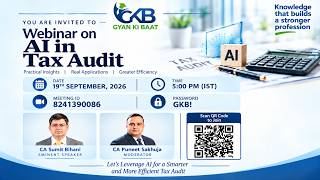
Webinar on applying AI to tax audit workflows, featuring tools built by AICA faculty member Sumit Bhayani for the chartered accountant community to reduce time-consuming tasks.
The Accounting Podcast explores Claude Cowork completing two business tax returns while catching software errors, plus EY's $100M staff bonus, Deloitte's $21M DEI settlement, and the shift toward o...

Inter-American Accounting Association hosts virtual panel on AI applications across accounting practice, covering private sector, public sector, and academic roles across the Americas.

Luca IQ debuts tax software with IRS e-file approval while Workday and Cherry Hill Advisory roll out AI agents for audit and tax work.