AI in Auditing: Benefits, Risks, and What Auditors Should Evaluate
Trullion examines AI's promise in audit—faster fieldwork, broader coverage, better risk detection—while highlighting what auditors should scrutinize before adopting vendor solutions.
Trullion examines AI's promise in audit—faster fieldwork, broader coverage, better risk detection—while highlighting what auditors should scrutinize before adopting vendor solutions.
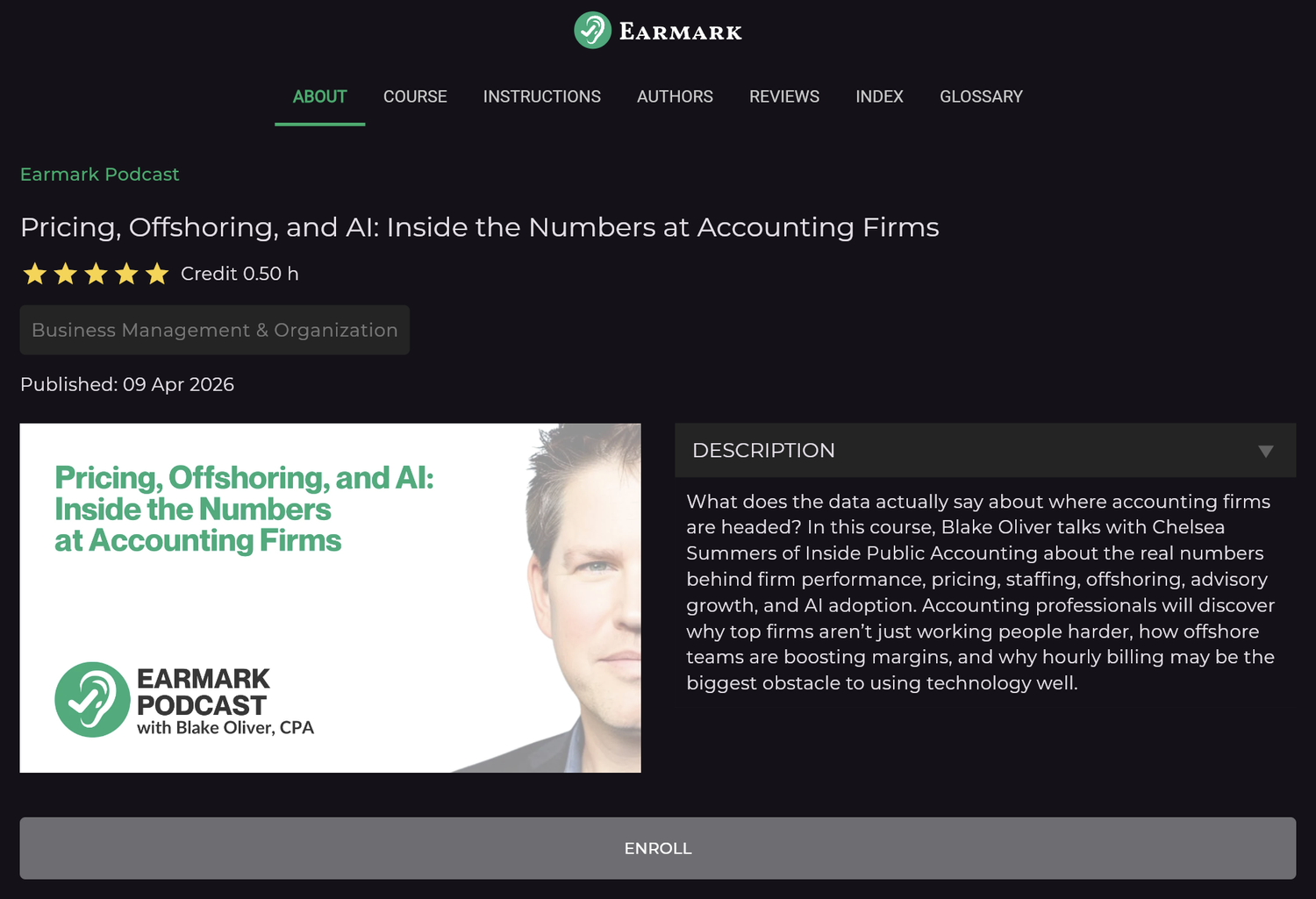
Two-thirds of accounting firm revenue still tied to hourly billing in 2025, creating perverse incentive against AI adoption since efficiency cuts billable hours and fees.

Blake Oliver interviews Sikich managing principal on how AI adoption is dismantling the classic accounting pyramid hierarchy and reshaping career paths for CPAs.

Blake Oliver argues traditional cost accounting misses AI's true impact; 80% of companies report zero productivity gains despite widespread AI investment, pointing to flawed measurement frameworks.

Professional liability insurers covering CPA firms are developing consensus that AI poses controllable risks requiring strong governance frameworks, though specific impacts remain unclear.

Internal audit teams should embed risk management early in AI lifecycle to help organizations innovate responsibly while managing AI-related compliance and governance challenges.

Accounting Today opinion piece argues AI isn't just automating tasks—it's fundamentally reshaping the role and value proposition of accounting professionals themselves.

CPA Practice Advisor argues the real story of AI in tax and audit isn't how widely it's adopted, but how it's fundamentally changing the work CPAs do and the profession's future.
Sikich managing principal Richard Lynch warns AI will eliminate routine accounting work, forcing firms to reshape training, billing, and career paths or face extinction—not adoption.
KPMG forecasts that routine audit testing could become the first major audit area performed almost entirely by AI within 2-3 years, raising questions about the future of human auditors and firm ope...
AI startup Perplexity moves into tax preparation and bookkeeping as IRS pilots Palantir to algorithmically select audit targets, raising questions about AI adoption ROI in accounting firms.
Digits breaks down three distinct AI implementation models in accounting software—AI-enabled, AI-native, and agentic—clarifying how architecture differences determine whether tools reduce work or j...
AccountingWeb explores best practices for incorporating AI tools into R&D tax relief claim preparation, balancing automation efficiency with regulatory accuracy requirements.
Accounting software relying on probabilistic AI models risks VAT return errors; deterministic approaches needed for tax accuracy.
BlackLine introduces agentic financial operations as intelligent orchestration of entire financial processes, marking evolution beyond simple automation for accounting teams.
BlackLine explores how AI automation streamlines order-to-cash processes—a core accounting function—reducing manual work and improving cash visibility for finance teams.
BlackLine explores trustworthy AI applications in financial closing workflows, positioning automation as a solution for faster period-end accounting cycles.
MindBridge warns that AI automation in finance is outpacing human oversight controls, creating compliance and accountability risks as transactions are classified and journaled in real-time without ...
Analysis questions whether LLMs can reliably answer tax questions, highlighting accuracy gaps in a core accounting use case.
Trullion's founder argues accounting tech must prioritize trust and auditability over speed, positioning human-in-the-loop AI as superior to autonomous agents.